Showing posts with label marketing. Show all posts

7 May 2012

Coolhaus : food trucks and marketing

Hello there ! 
Today (finally) an article about food marketing. I've decided to talk to you about Coolhaus, a foodtruck concept from the States, which sells to you icecream scoops between cookies. 6 cookie bases, 25 ice cream flavors.

Freya Estreller and Natasha Case, the two founders of Coolhaus

This article will analyze the entrepreneurial adventure behind the concept and of course the social networks strategy of Coolhaus. But before, I'd like to warmly thank Natasha Case, co-founder of Coolhaus, who kindly agreed to answer my questions, being the first (and certainly not the last entrepreneur) interviewed for @New Marketing Experience. 

The entrepreneurial adventure 

The concept was created in Los Angeles in 2008 by Natasha Case, architect, and Freya Estreller, estate developer. Coolhaus for a "cool house", made of walls of cookies and icecream (the name also being a reference to Rem Koolhaas, Dutch architect, and to Bahaus, designer of the 1920's and 1930's).
Architecture, besides being the past job of Natasha Case, is at the core of the brand strategy. For example, the ice cream flavors, amongst which the "Frank Behry" (strawberry iceacream and snickerdoodle cookies) for Frank Gehry. 


Frank Behry Sammy

But, while many flavors are architecture-inspired, some are just wildly unexpected, such as the fried chicken and waffle flavor (video below), and contribute to the originality and competitiveness of Coolhaus. 


Fried chicken and waffle ice cream by Coolhaus


In an article from the New York Times, we find out that the initial investment was (only) : 10 000 $, which covered the total buyout of a van on Craiglist, and its re-designing (painting, decoration...). See here for the whole article. 
The flavor concept was wrapped up with a lot of detailed attention, such as an eco-friendly wrapper for the sammies (name for the combination of ice cream + cookie), made out of potato and whose writing's are printed in soy ink. 

The concept has expanded rapidly thanks to media support, a great customer relationship and an innovative social networks strategy, and today Coolhaus has 5 trucks: 4 in Los Angeles, 2 trucks in Miami, 2 trucks and 1 cart in New York, 2 trucks in Austin, a store front in Culver City, and their ice cream sandwiches are also sold at Southern Californian Whole Foods Markets.


Social networks strategy 


Overall strategy

The number of press releases (from Huffington Post, LA magazine, NY Times...) has clearly played a role in the success of Coolhaus, but we shouldn't forget its social networks strategy, that has been essential in spreading the word.

Coolhaus and customers


What's crucial to know is that Coolhaus decided to launch their social networks strategy right from the beginning of the adventure : being a mobile business, it was essential to let use them in order to tell people where Coolhaus was. 


One of my questions to Natasha Case was about the difference in community management for the different trucks. Well, as it turns out, there is a social media manager, who oversees the corporate account and the work of each city manager. Then, for each city, you have a manager that does his own community management, supervised by the group social media manager. 


Facebook


A few number : Coolhaus's fan page has nearly 12 000 fans, and an equivalent number of Twitter followers. 

Coolhaus's Facebook Page


Specific promotions are made on Facebook, for example the organization of a flavor contest for fans on Facebook. Each Thursday, Coolhaus releases an ingredient, and fans have to make their own perfume out of that ingredient. Last week, the winning flavor was raspberry white chocolate cheesecake. Then, the following monday, a photo tagged with the name of the winner is posted on Facebook, exposed to anyone. The winner then gets a certificate for a free-sammie (the name of the cookie + icecream combination) and is qualified for the finale, which will oppose the 12 weekly winners of the contest. The winner of the finale will see his / her icecream flavor actually be created, sold, and named after him / her. 

The problem with this initiative is that, despite how great the initial idea is, the contest is not valorized enough on Facebook. For example, there is no specific application on the Facebook page that allows people to enter in their suggestion and see the other ideas that people have already have. This could potentially generate for engagement for the fans. 


Moreover, the Facebook posts of the brand generate few likes and few comments : the interaction of the brand is more made on Twitter, a more instantaneous mode of communication.

Twitter

You can find different Twitter accounts under the name of Coolhaus : One global twitter account for the brand : @coolhaus, and then different accounts for the different trucks: @coolhausny , @coolhausla, @coolhausATX, @coolhausMIA, @coolhausDFW.

Coolhaus on Twitter 

What's great with having a local account for each truck is that the information is very quick to diffuse, and managers can answer directly to questions of their followers. A great twitter strategy, which allows clear user engagement, compensating the lack of interactions on Facebook. 


Tumblr

Coolhaus has created a Tumblr, which gets around 15 notes (equivalents of sharing) for each post. A good point (but also a disadvantage) about this Tumblr is that Coolhaus does not focus on their products but post photos, recipes, architecture or news about what they do. For example, they wrote a couple of weeks ago an article about the last festival they went to.
Nevertheless, more photos of the events and of the Coolhaus truck and followers would be great : it's for instance nearly impossible to find pictures of the truck on an official Coolhaus device. Very easy on the global Internet to do so, but Coolhaus should take advantage of their great brand image and broadcast more photos themselves.

Pinterest

Coolhaus does have a Pinterest account, on which there are 75 pins and 81 likes. Coolhaus follows 153 users, is followed by 93 people and posts about architecture, logos and other cool stuff. But, like the Tumblr account, nearly no pictural information is given about Coolhaus. Maybe making a board dedicated to Coolhaus customers, events of trucks could give a more clear image of Coolhaus.

Coolhaus on Pinterest

However, Coolhaus does make a certain buzz on Pinterest, with more than 150 pins created by users other than Coolhaus. An example that clearly demonstrates that Coolhaus has targeted a hype market, very sensitive to new trends.


Conclusion(s)
For those of you who are near one of the Coolhaus trucks, I strongly advise you to follow them on Twitter and get a bite of their food. If I weren't on the other side of the ocean, I would run there straight away ! 
And for those of you entrepreneurs thinking about a food business to launch, you should carefully look into the food truck concept, a market in exponential growth (read the great article of Fast Company for more information about that). 
And finally an advice for brands : even if using social networks not to sell but to communicate with customers and share your commun interests is the right thing to do, not communicating enough on your brand image can be too restrictive. Don't hesitate sharing pictures of your employees, of your customers, of your products, people will appreciate your transparency !

The word of the end : Natasha's advice for entrepreneurs
"Trust your instincts : don't be afraid to do something truly unique; people will appreciate the courage and the end result !"


Thanks for being more and more readers on @New Marketing Experience. If you have any feedback (positive or negative), don't hesitate sending in a mail to lily.gros@gmail.com or a tweet to @newmarketingexp.

30 Apr 2012

Salomon v.s Patagonia : mountains, sports and marketing

Today, two mountain giants will be confronted in their e-marketing strategies. Ladies, and gentlemen let me introduce Salomon and Patagonia.


Two great businesses, both the USA 
Patagonia : born in the USA in the 1950's from the initiative of Yvon Chouinard, a young men passionate about climbing who had begun his own business of selling and producing climbing equipment. With the years, Patagonia has become known as one of THE references for alpinists, climbers, hikers and greenlovers of all kinds. If you want to know more about the history of the entreprise, do check out this page, filled with anecdotes about Yvon Chouinard and the evolution of the company.

Yvon Chouinard - founder of Patagonia

Its product universe today keeps on revolving around the mountain yet with an extended number of products: ski clothing, hiking shoes, climbing equipment and others... 

Salomon: a French company, created in 1947, was also created in the mountains and was selling skis from the beginning. Today, it sells hiking, running and skiing products (both alpine and cross-country skiing).

Georges Salomon - founder of Salomon

Like Patagonia, it is one of the main actors of the market of outdoor leisure and sports. 

There are differences in products between the two companies (Salomon for example constructs skiis, which does not do Patagonia), but their universes are very close. Likewise, both companies put forward their environmental engagement. For example, Patagonia with the Common Threads initiative (a double pact between Patagonia and people, in which both parts engage in significantly reducing their environmental impact - Patagonia by conceiving products respectful of the environment, and people by recycling, reusing and repairing products instead of buying new ones as often as possible).

Patagonia's Common Threads Initiative

The similarities between the two brands made me wonder : with such similar valors, business history and product universes, how do the two brands communicate ? And most of all, do they have a different communicational style ?

Site analysis

Patagonia's website has four sections : products, environment, videos and blog. You couldn't do clearer. 
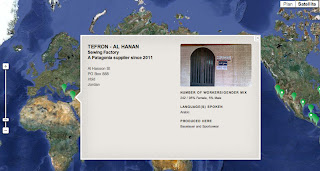
A very nice thing they have done is the footprint chronicles. Remember when I told you about Rapanui, an awesome british eco-textile company which made a map for each and every one of their products : the origin of the textile, where it was conditioned, where it took the boat... ? (if not, you can check it out here). Well, Patagonia has done something quite similar.
With their footprint chronicles they have created a map on which they have indicated all their suppliers (both textile mills and factories). You can directly click on one special point, and tada information about the supplier appear: the address, the date since when Patagonia started working with them, the number / gender of workers, the languages spoken, and what product is made there.


Footprint Chronicles - Patagonia

On the other side, Salomon's website is divided according to products : you have to choose your product universe (alpine ski, cross-country ski, trail running or hiking) and then a dedicated section opens up. Or you can choose to navigate more globally by type of product division (shoes or clothing). 
This division, quite intuitive enables a visitor to go straightly to what he desires : whether it is a specific pair of shoes or he searches for products to buy for his next hike. 

Moreover, in addition to these e-business divisions, a small toolbar right at the top of the Salomon website indicates the existence of four (even five) dedicated universe websites : salomonfreeski, salomon snowboard, salomon running, salomon racing and salomon nordic. Then, in each of these websites, you can have sections for : the presentation of the team, presentation of the gear, videos (or even webTV), and the link a blog dedicated to the subject of the site. 

Salomonsnowboard.com

Even though the multiplicity of sections in Salomon's websites allow people to have access to very rich and multiple content, it must be hard to manage such important flow of information : imagine having to create different pages in different websites just for one product. On a customer viewpoint, the navigation is quite simple : not as simple as Patagonia's, but it's still quite easy to find what you are looking for.

Interactive content : blogs and videos

As I've just presented, both companies have blogs. The different blogs of the company are well fed with relevant content: Patagonia and Salomon have clearly understood that behind the concept of blog is not only product promotion but broadcasting of news that potentially interest their customer. For example, the last post of Salomon Nordic was posting pictures of Kikkan Randall, worldcup champion.

Likewise, both Patagonia and Salomon use videos
- Patagonia has chosen to broadcast videos about their ambassadors (aka the people who test and promote their products). At first, I thought it was videos made by the ambassadors themselves but it appears that they are videos made by Patagonia. These videos are really beautiful to watch, ambassadors talk themselves about hiking, climbing, nature... and make you want to go hiking : a nice moviemaking in between National Geographic beautifully styled videos and amateur sports videos.

Lynn Hill at Hueco Tanks - A Patagonia video

However, promoting self-made videos could have been a great initiative, and a good way to create a relationship between the brand and its customers. And you could have imagined a total opening of video posting to people who may not be Patagonia ambassadors but at least Patagonia customers and lovers. 
A slight false note is the presentation of the videos themselves on the website : as beautiful as the videos are, they are not enough valorized on the website.

- Salomon's videos are on the contrary very well promoted, and surf more on the hype curve of sports videos. Haven't you noticed how many sports videos people share, tweet about today ? The popularization of very high-tech cameras such as proHD has without a doubt contributed to a dramatic increase in the number of sports people who just film their own sports exploits and post them on the Internet. Well, Salomon has very well exploited this change, and use the same graphic codes and tone than in these videos (for example, the amateur side of filming oneself)


And, moreover than just making nice-looking videos about, let's say, a snowboarder going down a mountain, Salomon also aims at creating content. For example, it has created a series of episodes about running : interviewing members of the Salomon Running team and letting them express what it is they like about running, and their advice to fellow runners.

A last good point about Salomon's videos is that they don't hesitate in turning themselves in ridicule. You can for example watch the video they made about their own ski vacation; for a brand that has over half a decade of existence, the tone is really young, and very refreshing.


Social networks 

And last of all but certainly not least, my analysis of their social networks strategy 

Salomon's social networks strategy is to have one global account for Salomon, and then dedicated pages to the universes of freeski, running, nordic, racing and snowboarding. The global Salomon page has more than 32 000 fans, but generates little user-created content. The posts made by Salomon receive few likes (a maximum of 60) and very few comments.
But on the other hand, the dedicated pages generate more interaction, especially when Salomon posts photos.

Salomon Freeski's Facebook page 

Yet, there is not enough participation from the users themselves : unlike other companies which I've talked about in my other articles, comments on the Facebook posts of the brand are not massive. Moreover, the brand does not directly incite the consumers / sports lovers to interact directly with the page (whether it is with games or photo contests). Instead, the brand generates vertical content about the last news, the results of the Salomon team. Too bad that users are not more incited to interact, because I'm sure they have a lot to say !

Likewise, Salomon uses its twitter accounts to give updates about what is going on. For example, the Salomon freeski account (@salomonfreeski) is described as "Random updates from the salomonfreeski.com team).


Patagonia 

Patagonia's Facebook profile is centralized and gathers more than 168 000 fans, with an average of 100 likes and 20 comments per official post. If we crack up the numbers, the score of Patagonia is higher than Salomon in terms of engagement per user.
Patagonia's Facebook account manager has cleverly arranged the account as to balance pictures and articles, so that the lecture of the timeline doesn't get too boring. The titles of the posts are very short (no more than 140 characters) and echo either to a past event about climbing, the firm, about news of the different stores (a quite moving note was for instance posted by a Japanese employee of the Sendai store, that had been impacted by the tsunami), about Patagonia ambassadors : a very diverse number of posts that doesn't leave time for users to get bored.

Patagonia's Facebook page

But then still, the users are not quite incited to participate in that content and post themselves content. It is true that Patagonia answers the Facebook users when relevant comments are made, but maybe more space could be given to consumers to express themselves.

I might have sounded harsh in my last statement, so let me make an amend : in terms of reactiveness, both the Facebook and the Twitter (@patagonia) account managers of Patagonia are proactive : answers are made to users very quickly, which tends to generate a positive interaction between users and the brand.

My conclusion / advice :
- Go hiking ! (for readers)
- Keep opening up your content to your users : Patagonia and Salomon are great examples of successful companies that have evolved in their core competencies and products, and have succeeded in maintaining their competitiveness despite the arrival of competitors. Now, the stakes rely on emphasizing customer fidelity and relationship !

18 Feb 2012

Sponges and marketing


I don’t know about you, but I’ve always wondered about the marketing strategies of rather odd or basic products, such as sponges. Can you really do an innovative marketing strategy to sell sponges ?
As you might have guessed, the answer is yes of course. But, how, you ask me ?

The marketing and communication strategy I chose to focus upon is Spontex’s, a french brand created in the 1930's and whose principal product is sponges... 

In 1999, Spontex launched a communication campaign starring a cute-as-can-be hedgehog, fallen in love with a sponge, whose characteristic was to be as scratching as the very same hedgehog.

Since then, the hedgehog has been the unstopped symbol of Spontex’s campaign, which allowed creating a somehow very cheeky tone in the very unsexy universe of sponges.

This campaign caused a huge buzz when it was broadcasted, and lead me to a question : how did the brand maintain the tone of the campaign?

The use of social media by Spontex is surprisingly very successful. The Facebook fan page (https://www.facebook.com/spontex) for the brand rassembles 197 419 fans. Their facebook strategy 
- Official posts, at least once a week
- Maintaining the same cheeky, and quite daring sometimes, tone as for the TV or print ads. For example, they have been publishing recently once a week, the "hot resolutions" of Ernie (the hedgehog, whose name appears to be quite known to Spontex lovers) 

Resolution n°9 - "In 2012, I will start music"

The hot resolutions are very followed by the fans of the facebook page and get between 100 and more than 400 likes, and 20 comments per post. 

One interesting thing to note is also the international success of Spontex's communication. Lots of amateur fan pages are created on Facebook, among which you can find a Ernie fan page in Germany (264 fans). 

- A harmonious communication between the print ads, the official website and the facebook page. Impertinent tone, and direct phrases are used : the allusions to sex are quite obvious and efficiently builds the loyalty of consumers to the brand. The official website directly refers to the Facebook page for games such as "find the G point"

- Keeping up with the news
Saint Valentine was one occasion for Spontex to publish a nice photo, in which the brand incited you to tag your friends...

... but more than that, Spontex also hijacks high-interest political facts, such as the current presidential election in France. 
This week, Nicolas Sarkozy, current French president, announced its candidacy to the 2012 Presidential election, with the slogan "La France forte" ("A strong France"), which Spontex diverted in to "La France frotte" (France is scrubing). A very nice pull, liked by nearly 700 people on the Spontex official page, and commented by nearly 40 users. 


However, to end with this analysis, Spontex's strategy has not always been the best, as shows the following video, broadcasted last year for Saint Valentine's day...

13 Jan 2012

Would zombies use iPhones ?

When I took the train this morning I saw a print ad for the series "The Walking Dead" and I wondered: how do series sell themselves? Do and can series use new technologies?

For the record, zombies, as well as vampires or other gloomy/freaky creatures, benefit from a very large online and offline buzz. Partially propelled by the success of Twilight (not that I endorse that movie, but I have to face its large success and buzz)

As an introduction, let me present to you two print campaigns to promote the series "The Walking Dead":

- Norway 


The Norwegian campaign (December 2011)

The principle of that campaign.
See the first poster? You could actually strip off bits of the poster to get the adress of the website www.foxcrime.no. Just as a zombie would fall apart. 

- France 


Translation in English : "I see dead people, and then I kill them"


Translation in English: The only good dead people are dead dead.

This print campaign was made by the agency NoSite, to promote the first broadcast of The Walking Dead on Sundance Channel France, for the 12th January. The aim of the campaign was to show the human side of zombies, which enables an even more shocking contrast between the characters and the catch-phrases.

NoSite, of which this print campaign was the first campaign, also animates the twitter account of Sundance Channel France, the French antenna of the American Sundance Channel, that will broadcast the Walking Dead in France. The aim of the Channel: broadcast independent American and foreign movies.
Seeing the campaign, I wondered if NoSite used other communicational devices. 
And the answer was: not really. 

- Use of Twitter: no twitter account was created for this specific campaign. Likewise, the Twitter account of Sundance Channel only relayed the information, therefore undermining all the surprise effects created by the print campaign.

- Use of Facebook: Sundance Channel France has more than 13 000 Facebook fans, but the information about the imminent broadcast of The Walking Dead was, just like on Twitter, only relayed. Photos of the print campaign were posted, but without any inspiring quotes, without all the zombie effect which attracts so many people to view The Walking Dead. 

There is clearly a lack of use of the success of the zombie phenomena, new technologies speaking. 
For instance, the Walking Dead Facebook account gathers nearly 5 million fans, with a minimum of 3000 likes for each post from the owner(s) of the page (AMC, the US channel that created The Walking Dead, and Mad Men for instance) and hundred of comments for those posts. 

NoSite could have used this success to make a more interactive campaign to promote the broadcast of The Walking Dead in France. There is a huge online community of The Walking Dead fans: aside from the official facebook and twitter accounts, there are at least a dozen of non-official accounts that gather thousands of The Walking Dead fans. 

The official French Facebook page for The Walking Dead nearly gathers 5 000 fans, but there is no information as to the official character of the page: who created it, for which purpose. Moreover, the owners of the page do not seem to control 100% of the content published on their page. Commercial links are for example posted without being controlled. 

My advice: zombies are great (in communication). Why not take advantage of the existence of a gigantic fan community to use breaking-through communicational devices. For example, QR codes, or smartphones apps which could use all the fantastic imaginary behind the concept of zombies.

Zombies, get yourselves iPhones. 

18 Dec 2011

Rapanui v.s Natimeo: is ecology wearable ?

When you think about ecology, you might think first of wind turbines, protection of polar bears or of the Amazonian forest...
According to Rapanui and Natimeo, ecology is not only that: shopping for clothes can be a way to invest yourself in the protection of nature and of humans !


A brief history 


Rapanui: a Isle-of-Wight based firm, founded by two brothers in their early twenties in 2008. Products: organic wear for men and women, produced in ethical factories, and energy-powered with wind turbines. The aim: make eco-fashion cool !
The products are not what you would expect organic wear to look like (no itchy brown socks and itchy smelly sweaters). And, in addition to being fashionable, they are very agreeable to wear.
Slogan : eco-fashion

Save our Seas T-shirt - Rapanui

Natimeo: created in 2011, Natimeo is a brand of the group Decathlon (sportswear and equipment). They furnish Decathlon's other brands in ethical and organic wear. For example, the image on your left is a merinos wool shirt they produced for the brand Domyos.
The products of Natimeo are not aimed at being fashionable but at fulfilling a promise of technicity of the product (not letting water pass through them, comfort for intense / sportive use of the clothes...)
Slogan : "let nature wear you"
Natimeo Wool Shirt

An innovative presentation of products

Both firms have understood very well what is at stake in customer relationship management, and more globally in the new terms of concrete marketing.

A global presentation of the issues of ecology 
People might know what ecology is ... or not. This is why both Natimeo and Rapanui explain their general approaches to ecology and their business models in specific pages. Video and image devices are very nicely displayed on the Natimeo website, from the second you enter the adress http://www.natimeo.com/ in your browser. 


The business model of Natimeo

The above video for example explains the steps of the Natimeo products, from the water used in the production of cotton to the final product.

The same global explanation is present throughout the Rapanui website, but their approach is more "product by product".

Presentation of the products: both sites aim at making traceability of the product from A to Z possible. Both Rapanui and Natimeo for example display maps of where the products come from (where the plants where produced, where they are transformed in a tee-shirt), how they are transformed, how they come to the consumer
However, Natimeo's presentation is more tricky: they do not sell directly the products they make : the products are sold through the other brands of Decathlon. And, Decathlon does not yet use a traceability map for each of its product. Moreover, on Decathlon's website, there is no specific rubric for organic products / products coming from Natimeo.
Of course, when you stumble on a Natimeo product, it is presented as such, but I haven't yet found devices that lead the consumer directly to more these more ethical and ecological products.

On the other hand, Rapanui do sell directly their products. Guidance through the products is very easy and you nearly instantaneously the product you were dreaming of. Nevertheless, these is a limited number of products, especially of the collection for women.
However, for the existing products, details about the product are very thorough and each product has their own specific webpage, where the consumer can find the traceability map and additional information about the product (why bamboo is more ecology-respectful than cotton for example).               

At the World Forum of Lille in november 2011, I had the opportunity of meeting with the founders of Rapanui, who took the time of explaining me their use of new technologies. For instance, the use of traceability maps was seen as an innovative device enabling the consumers to make a transparent choice.

The products of Rapanui are also sold in shops (38 independent retailers, and one owned shop) and making a transparent choice is there made possible by the use of QR codes. On each product, a QR code is attached, and linked to the traceability map of the concerned product. Therefore, the consumer can see, even if in a shop, where his / her product was made. 

Similarly, both firms promote eco-labels, to give their targets an easy way of determining the environmental and social impact of the products. 
      
Natimeo                                                          Rapanui 

Both indicators are very similar: the use of an A to E (and even A to F scale for Rapanui) scale, with colors (green : good, red : bad), that make recognition instantaneous. The principle is the same than that for cars for example. 
Let's note that for Rapanui, creating an eco-label, which can lead to a transparent choice for consumers, goes further than Natimeo: Rapanui has aims at creating a proposal to the European Commission, to extend the creation of this eco-label to the European level.
The various letters of the label can be translated into:
•    A – organic ethical sustainable
•    B – ethical with some work to sustainable
•    C – ethical
•    D – not bad, not good either
•    E – needs improving
•    F – some organic, ethical or sustainable
•    G – not organic, ethical or sustainable
(source : http://www.rapanuiclothing.com/ethical-fashion/eco-labelling-clothing.html) 

• Proximity with consumers
How Natimeo and Rapanui reach out to their consumers is different: 
- Social networks : Rapanui is present both on Facebook (2 081 fans) and on Twitter. They intensively use Facebook to direct consumers to their website, but the content is not perceived as spam: both the products and the ideas are presented, but not in a "commercial" point of view. It's more of a "hey ! Did you know that ?" communicational style. Moreover, adherents to the community benefit from regular discounts and information about the theme of ecology.
Natimeo is absent from Facebook and Twitter, a certain disadvantage. However, Decathlon, the final seller of products is very present on both networks, which helps nuancing this statement.

- Blogs. Both brands have understood that fixed contents are not the solution, and regularly produce updated content: the recent products, what the ambassadors are doing, discounts, commercial operations. Rapanui has even produced a Christmas documentary, very good initiative though the video itself (7:14 minuts) is rather long. 

The Grotto documentary - Rapanui

- People. Obviously, both firms have understood the importance of a quick customer service, and of the availability of a material contact. It is therefore very easy to find, on both websites, an email address. Moreover, the names and faces of people appear on the different pages of the website (for example, one of the co-founders of Rapanui appears as Father Christmas in the Grotto Documentary) 

Sports as a promotion tool
If Natimeo's final targets (through Decathlon) are sportsmen and women, the use of sport as a commercial argument is more exploited by Rapanui, who uses ambassadors (base-jumpers for example) to promote its brand and create a buzz ! 

• Rapanui's use of follow-up 
There is an additional number of devices Rapanui use that Natimeo doesn't : 
- A newsletter
An extract from a Rapanui newsletter (20th November 2011)

- When you order a product, you receive both an email when you have ordered it (to confirm the order) and an email when the product leaves Rapanui. This is quite classic, but what is not is the redaction of the emails, in a very informal tone : 
"We will keep you updated via email on the progress of your order, which will be processed and shipped to you shortly via UK 1st Class Delivery.
For any questions meanwhile we're only a phonecall away." (extract from an email received from Rapanui)

- The redaction of the whole website is in this same tone. We can compare it to Natimeo's use of smileys on their website, partially aimed at constructing a close relationship with its consumers. 
- You can ask for free Rapanui stickers 
- You receive a hand-written note in your package. The person who wrote mine even noted that I come from France since he / she wrote a joyful "Bonjour" to salute me.


=> Conclusions
Ecology has clearly took on a new step, with new products that correspond to the customers' expectations. And new business models such as that of Rapanui can be combined to older models like Decathlon : it is not only recent startups that can understand the importance of preserving the planet !
Moreover, it seems that both Natimeo and Rapanui have understood the new principles of marketing, and of establishing an informal and complicity relationship between firms and customers. Natimeo's use of new technologies for marketing purposes is still hesitant, but the firm was created very recently, that is three years after Rapanui. 

For Natimeo, the use of these new technologies stay undermined by Decathlon being the final seller of products. However, the similarities between both firms (the business-model, anchored around the notion of "circular economy" - see the Elen McArthur foundation for more information, the use of new customer relationship management, the use of informal communication tools, the use of traceability indicators) are astonishing, and might lead to a new marketing and business paradigm. 


For more, see : http://www.rapanuiclothing.com/ and http://www.natimeo.com/ 

</div> 

27 Nov 2011

Is M&S a trendsetter ?


Marks and Spencer's new store on Champs-Elysées
As you might have heard, Marks and Spencer came back in France last week. They opened a 1.400 m2  store on no less than the Champs-Elysées on November 24. This store’s opening was awaited by many people, mainly those who had witnessed the closure of all Marks and Spencer’s shops in France ten years ago. On the Champs-Élysées you could see dozens of impatient M&S lovers waiting to get their crackers back.
The clientele is different from that in England; while in the UK, Marks and Spencers addresses the classic housewife, the clientele is much larger in France: tourists, fashionistas, English ex-pats, English food lovers…

Rich tea biscuits 

Products: they are exactly the same than in the UK (name and descriptions in English…), but little signs in French tell the customer what’s so special about each product.
   
Is it just another Marks and Spencer store? Apparently, no. Marks and Spencer’s re-implantation in France also plays a role in their “bricks and clicks” strategy, which consists in combining the store and e-commerce offer. Last October, the French website http://marksandspencer.fr was launched, and enabled French customers, a month before the opening of the new M&S store, to order M&S products on a specific platform. The website, quite similar in contents and presentation to the international website (http://www.marksandspencer.com/) is in French, which is less confusing for French customers than the English website. Delivery prices are quite classic: 4,95€ under 5 days, 9,95€ under 2 days, free delivery over 35€. 
                   International website                       French website        
   
The store’s experience aims at combining both “live” sale and online sale. You can find 2 touch screen ordering points and 2 fixed iPads to buy products and be delivered home. At first, you might think “Why would I want to buy stuff online if I can get it right now?” Two main reasons: delivery facilities (do you really imagine yourself carrying 5 bags of Cadbury around Paris if you are on a 5-days trip?) and shopping facility (you don’t have to win a ruthless the girl next to you to get the last size 10 cardigan). A nice initiative, but a little bit too cautious technologically speaking: M&S will anyways attract customers to their brand new store so why not invest more massively in the use of new technologies?

Smartphone applications? None found… Which is again deceiving. Many concrete uses of smartphone applications could be imagined, for delivery tracking for instance. Indeed, an increasing number of customers require firms to produce a very precise delivery tracking system, on all kinds of support (website, mail, smartphone applications). Especially with the Christmas period coming up !
Once again, their website is quite classic, and doesn’t jump at your eyes as THE website where you will spend hours and hours, how much you may like M&S.

Where Marks and Spencer scores in terms of new technologies is their use of social media : they are present on Facebook (408 504 likes) and on Twitter (nearly 47 000 followers). M&S uses Facebook to present the current reductions and new products, through open questions such as “if I could have anything from Christmas from M&S it would be —". Even if their community doesn’t assemble a tremendous number of fans (compared to Cadbury for instance), M&S fans are attached to their brand and lively interact to the content produced by M&S. The Christmas question above for example received a total of 1077 commentaries (i.e "their bank account). Likewise, the twitter feed is very interactive, and M&S answers very quickly to the questions of their users. Let's note that M&S doesn't censor what users say: the comments are left as they are. A clever marketing, letting people know that M&S accepts some kinds of critics. 

My conclusion: a great new store, but a timid use of new technologies for now, especially on smartphone applications. M&S’s community one of their strong marketing assets, why not using it to become a trendsetter in new technologies? 

</div> 

19 Nov 2011

Beware of Pandas

Last septembre, Panda cheese (Egypt) launched a viral campaign. They broadcasted several videos, all with the same story, featuring the sweetest panda ever.
If you add the viewers of the 4 videos, the number of viewers add up to around 5 millions!
Why such a success ?
The only answer is on the video itself :

A great campaign, which has without a doubt contributed to getting people to know panda cheese and creating a real buzz. What's interesting is the hijack of the "nice panda" concept, symbolized by none other than WWF or Kung Fu Panda. The ad creates a total effect of surprise and that's what created the buzz. A very good use of the social aspect of youtube: the value's campaign, as perceived for the consumer, is to be able to share this video with people you know. And what better pretext for social interactions than a video of a kick-ass panda?

Apparently, the cheese itself has nothing special. On http://www.arabdairy.com/ you can see the different types of Panda cheese, which look quite normal (mozzarella, cream cheese, Parmesan). So, if ever that product comes to France, I don't think people will buy it for the product itself. The question is : will the fear for the Panda's reaction make us buy the cheese?