New Marketing Experience : comparing the use brands make of social media. How they change our use of products. How firms deal with it. And how YOU can use them.
Showing posts with label social networks. Show all posts
Showing posts with label social networks. Show all posts
In 1964, Road Dahl published a book that would become extremely popular : Charlie and the chocolate factory.
With Tim Burton's 2005 adaptation, the book became a movie and was made even more popular. But, farther than this, it has created an amazingly marketable tool : the golden ticket.
The principle of the golden ticket trick, also known as the Willy Wonka Trick consists in hidding in your products one or several golden tickets (that can also take other names) and associating a reward to the finding of these tickets. This very viral recipe will conclude in your customers' frantic quest for the tickets, so that they can win those precious prizes.
Today, an article to compare two recent campaigns using this golden ticket trick.
Nestlé - We will find you
In September 2012, Nestlé launched the operation "We Will Find you"
Nestlé's "We Will Find You"
The principle :
Hide a GPS inside 6 chocolate bars
Once this chocolate bar is found, the GPS is activated, and the winner receives 10 000£.
The communication relays:
• Video, as seen above
• Product packaging
• "Classic" advertising on bus stops
What was most interesting as we can see on this ad was the use of NFC. Thanks to the scanning of the QR Code / use of NFC tags, you could enter the competitions and see how many tags were left !
This campaign was very well relayed by numerous websites, french as english, so I will not extend upon it.
Instead, I would like to introduce another brand's perhaps less well known use of the golden ticket trick.
Michel et Augustin
Michel et Augustin is a french patisserie brands on which I have already written an article here. I had presented very briefly the principle of the four golden cows (les "4 vaches en or") and have decided to go more in depth here.
Michel et augustin's Four Golden Cows
The principle : make the consumers and internet users search for the four golden cows. They could be won :
- When buying a giant cookie (Cookie des rois)
- When finding the cow on the website
- By winning the lotery on their site (lotery to which 8 970 people registered)
- "Somewhere in France"
Today there still remains one ticket to be found in the giant cookie, finding which will close the contest !
During the first edition of the contest, I had observed the competition, and quite a lot of people where very active on the facebook page of the brand, relating which pages the golden cow could not be found on. But it took quite a while finding the cow, given that the Michel et Augustin team would have hidden it in a remote corner of their website.
The communication relays :
• The picture above is the homepage of their website
• This picture is relayed on their Facebook page, with the following cover picture
Michel et Augustin advertising for "4 vaches en Or" in Clermont-Ferrand
In conclusion, a very interactive, and rather low-cost viral strategy.
One last piece of advice : do not hesitate in making teasers of this kind of campaign, behind-the-scenes videos, making-offs... They will only increase the virality of the operation ! The key success factor being of course the virality of the operation. Two main KPI (key performance indicators) for this type of campaign : the number of incremental products sold, and of course the incremental augmentation of the social media used to relay the campaign with.
For now, the golden ticket trick has mainly been applied to the domain of sweets, candy and other delicious things. What could be most interesting would be to see another kind of brand use this technique : luxury for example.
And you, what are your favourite golden tickets campaigns ?
Today (finally) an article about food marketing. I've decided to talk to you about Coolhaus, a foodtruck concept from the States, which sells to you icecream scoops between cookies. 6 cookie bases, 25 ice cream flavors.
Freya Estreller and Natasha Case, the two founders of Coolhaus
This article will analyze the entrepreneurial adventure behind the concept and of course the social networks strategy of Coolhaus. But before, I'd like to warmly thank Natasha Case, co-founder of Coolhaus, who kindly agreed to answer my questions, being the first (and certainly not the last entrepreneur) interviewed for @New Marketing Experience.
The entrepreneurial adventure
The concept was created in Los Angeles in 2008 by Natasha Case, architect, and Freya Estreller, estate developer. Coolhaus for a "cool house", made of walls of cookies and icecream (the name also being a reference to Rem Koolhaas, Dutch architect, and to Bahaus, designer of the 1920's and 1930's).
Architecture, besides being the past job of Natasha Case, is at the core of the brand strategy. For example, the ice cream flavors, amongst which the "Frank Behry" (strawberry iceacream and snickerdoodle cookies) for Frank Gehry.
Frank Behry Sammy
But, while many flavors are architecture-inspired, some are just wildly unexpected, such as the fried chicken and waffle flavor (video below), and contribute to the originality and competitiveness of Coolhaus.
Fried chicken and waffle ice cream by Coolhaus
In an article from the New York Times, we find out that the initial investment was (only) : 10 000 $, which covered the total buyout of a van on Craiglist, and its re-designing (painting, decoration...). See here for the whole article.
The flavor concept was wrapped up with a lot of detailed attention, such as an eco-friendly wrapper for the sammies (name for the combination of ice cream + cookie), made out of potato and whose writing's are printed in soy ink.
The concept has expanded rapidly thanks to media support, a great customer relationship and an innovative social networks strategy, and today Coolhaus has 5 trucks: 4 in Los Angeles, 2 trucks in Miami, 2 trucks and 1 cart in New York, 2 trucks in Austin, a store front in Culver City, and their ice cream sandwiches are also sold at Southern Californian Whole Foods Markets.
Social networks strategy
Overall strategy
The number of press releases (from Huffington Post, LA magazine, NY Times...) has clearly played a role in the success of Coolhaus, but we shouldn't forget its social networks strategy, that has been essential in spreading the word.
Coolhaus and customers
What's crucial to know is that Coolhaus decided to launch their social networks strategy right from the beginning of the adventure : being a mobile business, it was essential to let use them in order to tell people where Coolhaus was.
One of my questions to Natasha Case was about the difference in community management for the different trucks. Well, as it turns out, there is a social media manager, who oversees the corporate account and the work of each city manager. Then, for each city, you have a manager that does his own community management, supervised by the group social media manager.
Facebook
A few number : Coolhaus's fan page has nearly 12 000 fans, and an equivalent number of Twitter followers.
Coolhaus's Facebook Page
Specific promotions are made on Facebook, for example the organization of a flavor contest for fans on Facebook. Each Thursday, Coolhaus releases an ingredient, and fans have to make their own perfume out of that ingredient. Last week, the winning flavor was raspberry white chocolate cheesecake. Then, the following monday, a photo tagged with the name of the winner is posted on Facebook, exposed to anyone. The winner then gets a certificate for a free-sammie (the name of the cookie + icecream combination) and is qualified for the finale, which will oppose the 12 weekly winners of the contest. The winner of the finale will see his / her icecream flavor actually be created, sold, and named after him / her.
The problem with this initiative is that, despite how great the initial idea is, the contest is not valorized enough on Facebook. For example, there is no specific application on the Facebook page that allows people to enter in their suggestion and see the other ideas that people have already have. This could potentially generate for engagement for the fans.
Moreover, the Facebook posts of the brand generate few likes and few comments : the interaction of the brand is more made on Twitter, a more instantaneous mode of communication.
What's great with having a local account for each truck is that the information is very quick to diffuse, and managers can answer directly to questions of their followers. A great twitter strategy, which allows clear user engagement, compensating the lack of interactions on Facebook.
Tumblr
Coolhaus has created a Tumblr, which gets around 15 notes (equivalents of sharing) for each post. A good point (but also a disadvantage) about this Tumblr is that Coolhaus does not focus on their products but post photos, recipes, architecture or news about what they do. For example, they wrote a couple of weeks ago an article about the last festival they went to.
Nevertheless, more photos of the events and of the Coolhaus truck and followers would be great : it's for instance nearly impossible to find pictures of the truck on an official Coolhaus device. Very easy on the global Internet to do so, but Coolhaus should take advantage of their great brand image and broadcast more photos themselves.
Pinterest
Coolhaus does have a Pinterest account, on which there are 75 pins and 81 likes. Coolhaus follows 153 users, is followed by 93 people and posts about architecture, logos and other cool stuff. But, like the Tumblr account, nearly no pictural information is given about Coolhaus. Maybe making a board dedicated to Coolhaus customers, events of trucks could give a more clear image of Coolhaus.
Coolhaus on Pinterest
However, Coolhaus does make a certain buzz on Pinterest, with more than 150 pins created by users other than Coolhaus. An example that clearly demonstrates that Coolhaus has targeted a hype market, very sensitive to new trends.
Conclusion(s)
For those of you who are near one of the Coolhaus trucks, I strongly advise you to follow them on Twitter and get a bite of their food. If I weren't on the other side of the ocean, I would run there straight away !
And for those of you entrepreneurs thinking about a food business to launch, you should carefully look into the food truck concept, a market in exponential growth (read the great article of Fast Company for more information about that).
And finally an advice for brands : even if using social networks not to sell but to communicate with customers and share your commun interests is the right thing to do, not communicating enough on your brand image can be too restrictive. Don't hesitate sharing pictures of your employees, of your customers, of your products, people will appreciate your transparency !
The word of the end : Natasha's advice for entrepreneurs
"Trust your instincts : don't be afraid to do something truly unique; people will appreciate the courage and the end result !"
Thanks for being more and more readers on @New Marketing Experience. If you have any feedback (positive or negative), don't hesitate sending in a mail to lily.gros@gmail.com or a tweet to @newmarketingexp.
Today, two mountain giants will be confronted in their e-marketing strategies. Ladies, and gentlemen let me introduce Salomon and Patagonia.
Two great businesses, both the USA
Patagonia : born in the USA in the 1950's from the initiative of Yvon Chouinard, a young men passionate about climbing who had begun his own business of selling and producing climbing equipment. With the years, Patagonia has become known as one of THE references for alpinists, climbers, hikers and greenlovers of all kinds. If you want to know more about the history of the entreprise, do check out this page, filled with anecdotes about Yvon Chouinard and the evolution of the company.
Yvon Chouinard - founder of Patagonia
Its product universe today keeps on revolving around the mountain yet with an extended number of products: ski clothing, hiking shoes, climbing equipment and others...
Salomon: a French company, created in 1947, was also created in the mountains and was selling skis from the beginning. Today, it sells hiking, running and skiing products (both alpine and cross-country skiing).
Georges Salomon - founder of Salomon
Like Patagonia, it is one of the main actors of the market of outdoor leisure and sports.
There are differences in products between the two companies (Salomon for example constructs skiis, which does not do Patagonia), but their universes are very close. Likewise, both companies put forward their environmental engagement. For example, Patagonia with the Common Threads initiative (a double pact between Patagonia and people, in which both parts engage in significantly reducing their environmental impact - Patagonia by conceiving products respectful of the environment, and people by recycling, reusing and repairing products instead of buying new ones as often as possible).
Patagonia's Common Threads Initiative
The similarities between the two brands made me wonder : with such similar valors, business history and product universes, how do the two brands communicate ? And most of all, do they have a different communicational style ?
Site analysis
Patagonia's website has four sections : products, environment, videos and blog. You couldn't do clearer.
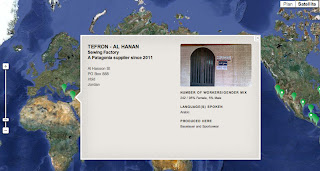
A very nice thing they have done is the footprint chronicles. Remember when I told you about Rapanui, an awesome british eco-textile company which made a map for each and every one of their products : the origin of the textile, where it was conditioned, where it took the boat... ? (if not, you can check it out here). Well, Patagonia has done something quite similar.
With their footprint chronicles they have created a map on which they have indicated all their suppliers (both textile mills and factories). You can directly click on one special point, and tada information about the supplier appear: the address, the date since when Patagonia started working with them, the number / gender of workers, the languages spoken, and what product is made there.
Footprint Chronicles - Patagonia
On the other side, Salomon's website is divided according to products : you have to choose your product universe (alpine ski, cross-country ski, trail running or hiking) and then a dedicated section opens up. Or you can choose to navigate more globally by type of product division (shoes or clothing).
This division, quite intuitive enables a visitor to go straightly to what he desires : whether it is a specific pair of shoes or he searches for products to buy for his next hike.
Moreover, in addition to these e-business divisions, a small toolbar right at the top of the Salomon website indicates the existence of four (even five) dedicated universe websites : salomonfreeski, salomon snowboard, salomon running,salomon racing and salomon nordic. Then, in each of these websites, you can have sections for : the presentation of the team, presentation of the gear, videos (or even webTV), and the link a blog dedicated to the subject of the site.
Salomonsnowboard.com
Even though the multiplicity of sections in Salomon's websites allow people to have access to very rich and multiple content, it must be hard to manage such important flow of information : imagine having to create different pages in different websites just for one product. On a customer viewpoint, the navigation is quite simple : not as simple as Patagonia's, but it's still quite easy to find what you are looking for.
Interactive content : blogs and videos
As I've just presented, both companies have blogs. The different blogs of the company are well fed with relevant content: Patagonia and Salomon have clearly understood that behind the concept of blog is not only product promotion but broadcasting of news that potentially interest their customer. For example, the last post of Salomon Nordic was posting pictures of Kikkan Randall, worldcup champion.
Likewise, both Patagonia and Salomon use videos
- Patagonia has chosen to broadcast videos about their ambassadors (aka the people who test and promote their products). At first, I thought it was videos made by the ambassadors themselves but it appears that they are videos made by Patagonia. These videos are really beautiful to watch, ambassadors talk themselves about hiking, climbing, nature... and make you want to go hiking : a nice moviemaking in between National Geographic beautifully styled videos and amateur sports videos.
Lynn Hill at Hueco Tanks - A Patagonia video
However, promoting self-made videos could have been a great initiative, and a good way to create a relationship between the brand and its customers. And you could have imagined a total opening of video posting to people who may not be Patagonia ambassadors but at least Patagonia customers and lovers.
A slight false note is the presentation of the videos themselves on the website : as beautiful as the videos are, they are not enough valorized on the website.
- Salomon's videos are on the contrary very well promoted, and surf more on the hype curve of sports videos. Haven't you noticed how many sports videos people share, tweet about today ? The popularization of very high-tech cameras such as proHD has without a doubt contributed to a dramatic increase in the number of sports people who just film their own sports exploits and post them on the Internet. Well, Salomon has very well exploited this change, and use the same graphic codes and tone than in these videos (for example, the amateur side of filming oneself)
And, moreover than just making nice-looking videos about, let's say, a snowboarder going down a mountain, Salomon also aims at creating content. For example, it has created a series of episodes about running : interviewing members of the Salomon Running team and letting them express what it is they like about running, and their advice to fellow runners.
A last good point about Salomon's videos is that they don't hesitate in turning themselves in ridicule. You can for example watch the video they made about their own ski vacation; for a brand that has over half a decade of existence, the tone is really young, and very refreshing.
Social networks
And last of all but certainly not least, my analysis of their social networks strategy
Salomon's social networks strategy is to have one global account for Salomon, and then dedicated pages to the universes of freeski, running, nordic, racing and snowboarding. The global Salomon page has more than 32 000 fans, but generates little user-created content. The posts made by Salomon receive few likes (a maximum of 60) and very few comments.
But on the other hand, the dedicated pages generate more interaction, especially when Salomon posts photos.
Salomon Freeski's Facebook page
Yet, there is not enough participation from the users themselves : unlike other companies which I've talked about in my other articles, comments on the Facebook posts of the brand are not massive. Moreover, the brand does not directly incite the consumers / sports lovers to interact directly with the page (whether it is with games or photo contests). Instead, the brand generates vertical content about the last news, the results of the Salomon team. Too bad that users are not more incited to interact, because I'm sure they have a lot to say !
Likewise, Salomon uses its twitter accounts to give updates about what is going on. For example, the Salomon freeski account (@salomonfreeski) is described as "Random updates from the salomonfreeski.com team).
Patagonia
Patagonia's Facebook profile is centralized and gathers more than 168 000 fans, with an average of 100 likes and 20 comments per official post. If we crack up the numbers, the score of Patagonia is higher than Salomon in terms of engagement per user.
Patagonia's Facebook account manager has cleverly arranged the account as to balance pictures and articles, so that the lecture of the timeline doesn't get too boring. The titles of the posts are very short (no more than 140 characters) and echo either to a past event about climbing, the firm, about news of the different stores (a quite moving note was for instance posted by a Japanese employee of the Sendai store, that had been impacted by the tsunami), about Patagonia ambassadors : a very diverse number of posts that doesn't leave time for users to get bored.
Patagonia's Facebook page
But then still, the users are not quite incited to participate in that content and post themselves content. It is true that Patagonia answers the Facebook users when relevant comments are made, but maybe more space could be given to consumers to express themselves.
I might have sounded harsh in my last statement, so let me make an amend : in terms of reactiveness, both the Facebook and the Twitter (@patagonia) account managers of Patagonia are proactive : answers are made to users very quickly, which tends to generate a positive interaction between users and the brand.
My conclusion / advice :
- Go hiking ! (for readers)
- Keep opening up your content to your users : Patagonia and Salomon are great examples of successful companies that have evolved in their core competencies and products, and have succeeded in maintaining their competitiveness despite the arrival of competitors. Now, the stakes rely on emphasizing customer fidelity and relationship !
You might have noticed the last ads of Peugeot to sell their car 107, rebaptisted "Envy". What I'm going to talk today about is girl marketing : marketing applied to feminine targets. But before learning all about that, take a look at Peugeot's new TV spot.
"Envy" - Peugeot's ad for the new 107
What is girl marketing ?
More and more ads today tend to put forward young, active, sexy and urban, in short full of peps, women. Women who are also consumers.
What do these ads tell their consumers ? Simply that its allright to be young, active, urban and comfortable with consumerism. Yes, for these ads, consumerism is not a default and shopping is a quality, something that puts you, as a young woman, in valor.
Compared to the 90's ads of Kookai (French clothing company), of which you can see an example below, these ads are very subtle in defending consumerism. Not only is the image of man objectivized (as you can see below in the ad for Guerlain's "La petite robe noire"), but the image of women is put in valor : women are not ruthless womanizers. The only motto is "it's allright to consume"
Man-object - Kookai
I will not adopt a feminist point of view in this article, it's not my role. Yes these ads can be criticized on the image they convey of women in general, but they are still effective in their object, which is why I will make an article about this type of "girl marketing"
Graphic tendencies
A short point about the graphics of this tendencies
- A first tendency is making very sleek designs. For example, the clip "La petite robe Noire" for the new perfume La petite robe noire (the little black dress) of Guerlain.
La petite robe noire - Guerlain
Associated with drawers / bloggers such as the very-well known in France Penelope Bagieu (http://www.penelope-jolicoeur.com/), this kind of graphics generally puts in scene black-painted bodies, and very edge cut shapes. Another example is the graphics of My Little Box (http://www.mylittlebox.fr/), company whose social network strategy will be developed later in this article.
- Or, on the other hand you have very colorful, punchy and "round" graphics, like that in the "Envy" ad for Peugeot 107
Fructis - The evolution of style
Another example would be the very remarked spot for Fructis shampoos, very modestly named "The evolution of style"
Two example of social networks strategies - My Little Box and La Petite Robe Noire (Guerlain)
My Little Box
My first example: My Little Box. Created last December, the concept of My Little Box comes from a newsletter about good deals in Paris. And then, the creator decided to let her readers take advantage of her advantageous beauty tips and advice.
The principle is the following: every month (on the 15th of May), you receive your "Little box", which contains 4/5 beauty products and some beauty advice / goodies. Every little box has been themed since the creation of the concept (last December). For example, this month's Little Box's theme was "New York".
My Little Box
The main stream that marketers can use to do a successful social networks strategy aimed at a feminine target is to play on the social aspect of girl marketing: I find it you will agree with me that feminine shopping in general is made in group of girlfriends.
Social commerce (defined by Fred Cavazza http://www.fredcavazza.net/ as "a sub-ensemble of e-commerce that implies the use of social media to stimulate social interactions and the contributions of users, and facilitating selling goods and services online") is therefore a useful leverage to create a participative relationship with consumers.
The interactions on the Facebook page of My Little Box are very surprising and the brand generates a lot of UGC (user-generated content). For example, this user who received today her beauty box and who said she would keep the other Facebook fans of the brand posted. As for today, My Little Box has more than 7 500 fans, with more than 1 600 shares of its content. The posts made are not only product placements but also general posts about beauty and style, and can be the latest news about the products as well as art-like photographies, which the community deeply appreciates, thus creating UGC.
Guerlain
The Facebook page for Guerlain's new perfume La petite robe noire (https://www.facebook.com/lapetiterobenoire) already has 3 350 fans, and has put in place a very effective and more important interactive communication. The little black dress speaks in first person and adresses directly the consumers. On the 3 350 fans of the brand, nearly 25% talk about the brand (share its content), a good virality rate.
With very short-content-posts, Guerlain get direct responses from the consumers, with only 11 posts (the perfume was released in stores on 5th March).
Let's note that Guerlain's Facebook communication is not this recent. With the official Guerlain Facebook page (https://www.facebook.com/Guerlain), we can observe a larger social networks strategy. However, the dialog is not the same as Guerlain's official page is more about product placement or introduction of new products.
Guerlain on Facebook
A strategy which seems less appreciated than the direct strategy used for La petite robe Noire. For example, for more than 201 000 fans for the official Guerlain page, there are around 100 likes for each post from Guerlain. On the other hand, La Petite Robe Noire receives around 100 likes (the numbers indicated here are averages based on the total number of likes for the posts) for each post, with a total of 3 350 fans.
And Twitter ?
Guerlain is however not present yet on Twitter, as a brand or as La petite Robe noire. This can be perceived as a lack of audacity, but which is quite comprehensible : luxury is a difficult segment to impone on social networks and even if the Facebook communication for La Petite Robe noire is very successful, its Twitter strategy cannot be similar, and should create specific content for Twitter users. However, it is true that many tweets have been made about La Petite Robe Noire, so it could be a good idea for Guerlain to launch themselves on Twitter, especially if they continue using
Bonus - Axe and Girl power
As a bonus, a last ad promoting girl power ! An ad quite surprising because coming from Axe, a brand quite known to promote a certain image of women as objects of beauty and sexuality (which does not deny that their marketing campaigns are very effective and nice to watch)
On your left, the Arpenaz 400 L pants, with mixed components (part organic coton, part spandex).
And on your right, a 100% organic coton tee-shirt.
Both the pants and the tee-shirt are very confortable, easy to wear and don't loose their colours. Which is why I have a solid "Yes" answer to the question "is ecology wearable ?"
The comparison I would make with Rapanui is style-wise : being designed for sports, Natimeo products are not as stylish as Rapanui's. One of their first products was a limited edition teeshirt with the slogan "recycle, reduce, reuse. Too bad it's still not in stores...
My question: how can you communicate on organic wear ?
The first intuition of many people told about organic wear is to say "organic wear... what's that ? I thought only food was organic". Therefore, in order to clarify your positioning, the first step as an organic wear producer is to make your consumers aware about what is organic wear. This way, your consumers will understand why choosing organic wear when they need new clothes is a more ethical and responsible choice.
An example: Merinos wool by Natimeo
As you might have expected, I also recommend using social networks to communicate on your brand (assuming you are launching a line of eco-wear or organic products). For now, Natimeo is not yet present on social networks, but as it is a new brand and that its products are sold under the label "Oxylane", it is not a major default.
What I want to insist in this post is on the importance that ecology is taking not only in theoretical debates but also in business. Look around you and you will see that more and more brands try to develop towards more ecological responsability or even base their entire business model on more respect of Nature.
Natimeo is the perfect illustration of this tendency : it is part of a historical international group and yet it takes into account these new dynamics. It is very likely that the share of Natimeo products in the store shelves of our Decathlon stores will dramatically increase in the following years, so watch out, ecology is coming, and its growing fast !
The question of the day is: how can brands create real and sustainable traffic on their Facebook pages ?
Many solutions are possible but today I will only present three recent and possibly most pertinent ones to you!
Use humour
One of my favorite pages as a marketer and as a consumer is the Oasis Facebook page (for the record, Oasis is a French brand of softdrinks). Content is regularly diffused on the page (https://www.facebook.com/oasisfunpage) : every 2-4 days or so, and yet it attracts many likes and comments per post. You can at least count a bare minimum of 1 000 likes and 60 comments per post.
Why this success? The graphic quality of Oasis' marketing campaigns does have an important share in that, but my belief is that Oasis has understood what social networkers want from them : humour. All the non-socialmedia ads of Oasis are based on fun and humour and the same tone is conveyed through their Facebook page.
A subtle technique : using the news
Two examples, inspired from the very recent victory of Jean Dujardin, first French actor to ever win the Oscar of the best actor.
Oasis- The Poirtist
Ernie the hedgehog is back - The Grattist
Personalize your content
When you are a brand, you have to produce content in order to maintain a certain level of attention from your fans, but you also have to thank your fans. Many brands today don't hesitate in thanking frequently their fans, by posting phrases such as "thanks for being so many to like our page" in their weekly posts. Some brands go further and make dedicated fan-thankyou actions.
These type of operations can be adressed to the community of fans as a whole or search maximum individualization. Here are two examples:
Heinz's thank you post after reaching their 50 000th Facebook fan
Oasis' thank you after reaching 2 million Facebook fans.
For this operation, Oasis created a special application, which took your profile picture and included it in a portrait starring a fruit of the brand and a thank you note.
Create a competition between social networkers
The principle here would be using first the network of social networkers already fans of a brand, and the buzz potential of a brand to create a truly interactive contest. This could be for example a photo contest in which fans have to take pictures of themselves with a product of the brand in order to win the prize, with the condition that the picture with the maximum number of likes on Facebook wins the contest.
Why does this work? Because fans who play the game become highly involved in the contest and generally motivate a high number of their Facebook friends in order to win the contest.
And thanks to a virality effect, assuming the brand has done previous efficient communication, the site and contest attracts thousands of curious people.
My example: the Heinz Art Challenge
The challenge: draw online, with virtual ketchup, a composition of your choice on a plate in order to win the printing of your drawing on 3 unique plates.
List of winners of the contest
Ad for the promotion of the Heinz Art Challenge
However, there is a danger of non-implication of those fans and a risk of a very ephemeral relationship. Which is why brands should not only use contests in order to create traffic on their Facebook pages and should vary their initiatives.
Thanks to all of you readers who contribute to my pleasure in writing this blog. Don't hesitate to answer to the posts, give your advice or disagree with me. Debate is highly encouraged !
These days, when walking in the streets,
listening to the radio, shopping, you might be overwhelmed images of Tintin, especially in France.
Triggered
by the release of the cinematographic adaptation by Steven Spielberg of Tintin
(The Adventures of Tintin – Secret of the unicorn : the first of a trilogy of movies).
This love for Tintin is not a new phenomenon, far from there (the
blond reporter’s first appearance dates back to 1929) but only this year has
Tintin started to invade the communicational sphere.
McDonalds, Pitch (Pasquier Group), Carrefour, media : many are
those who take advantage of the character to promote their own products.
Did
firms use traditional communication devices or an innovative, 360° degree,
communication ?
All we understand is
that Pitch (mainly brioche type pastries) used the image of Tintin to promote its products.
They have a nicely
designed website : http://www.pitch-tintin.com/ , but not interactive at all. You can fill up
a form to participate to the “treasure hunt”. A treasure hunt which is merely
the possibility (by filling up this form) of wining prices (amongst which a
trip to Belgum). But that’s all.
Most shocking of all : Pitch is
not even on Facebook ! Even if the entry on social networks is difficult for a brand (between giving too much or not enough liberty to consumers, the right balance is find to hard), taking them into account and using them is vital to create
a real relationship between brand and customer.
• Carrefour's "Mille milliards de promos" (translated in English by "billions
of blistering promotions"– a word pun on the famous Haddock swear expression "billions
of blistering blue barnacles").
This is quite a traditional campaign (disposal of advertisement
posters in which characters from the movie are featured). An effort to note was the creation of a dedicated website (http://www.les-aventures-de-tintin.carrefour.fr/ ) to promote the operation. But the content
doesn’t enable a full participation of lovers of Carrefour.
The principle of the operation is the same as Pitch’s: possibility of wining
prices. In addition here: the possibility of collecting Tintin figurines
available in Stores. But once again, no interactive device (no Smartphone application, and absence from social networks, even if a Facebook share button and a Tweet button have been added at the bottom of the website.
My conclusions: TINTIN WOULD NOT USE A SMARTPHONE. Tintin-centered campaigns are quite
disappointing: lack of innovativeness, lack of use of new technologies (no
smartphone application found yet)…
What's even more shocking is the lack of use of 3D, nevertheless one of the arguments for the innovativeness of the new movie !
These
campaigns are more the less deceptive that Tintinology (collecting Tintin-based products, and the adventures of
Tintin themselves are a symbol of adventure, and of the search for
experimentation).
What’s Next ? For a successful 360° communication, wait for my next article
“Timberland and CSR : how new technologies are the best way of selling recycled
products” </div>